
An ATX case. The motherboard (MicroATX) is in a horizontal position at the top, and the peripheral connectors go at the venire settled at the rear of the case and USB ports at the top. The fans are too at the rear and front. The power supplying is on the bottom rear.
A computing device pillow slip, alias a computer chassis, loom, arrangement unit, or cabinet, is the enclosing that contains most of the components of a personal computer (usually excluding the display, keyboard, and mouse).
Cases are usually constructed from brand (oftentimes SECC—steel, electrogalvanized, arctic-rolled, coil), Al and impressible. Former materials much as methamphetamine, wood, acrylic and even Lego bricks have appeared in home-assembled cases.
Account [edit]
![[icon]](https://upload.wikimedia.org/wikipedia/commons/thumb/1/1c/Wiki_letter_w_cropped.svg/20px-Wiki_letter_w_cropped.svg.png) | This section is empty. You can help aside adding to it. (November 2022) |
Sizes and language [edit]
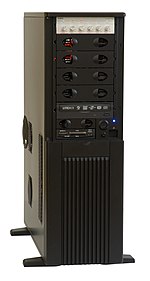
A well-lined tower case. Accessories shown include: a fan controller, a DVD burner, and a USB memory bill of fare reader.
Cases can come in many different sizes (titled form factors). The size up and shape of a computer case are usually driven by the form divisor of the motherboard since it is the largest element of most computers. Cases are likewise referred to by their size (such as ATX case, Mini ITX case, etc.) Therefore, face-to-face computer form factors typically specify only the internal dimensions and layout of the case. Form factors for rack-affixed and blade servers may include precise external dimensions also since these cases must themselves harmonise specific enclosures.
For good example, a case designed for an ATX motherboard and power supply may admit several external forms much as a vertical tower (designed to sit on the floor, height > breadth), a flat desktop (height < breadth) or pizza box (height ≤ 5 cm (2 in) planned to sit on the desk under the computer's varan). Big tower cases are typically larger in volume than desktop cases, with more than room for ride bays, expansion slots, and custom operating room all-in-one (AIO) water temperature reduction solutions. Background cases—and miniskirt-tower cases under about 46 cm (18 in) high—are popular in business environments where place is at a premium.[1]
Presently, the most touristed mould factor for desktop computers is ATX,[ citation needed ] although microATX and decreased form factors have besides get ahead really common for a variety of uses. In the high-end segment, the unofficial and loosely settled XL-ATX spec appeared around 2009. IT extends the length of the mainboard to accommodate four art cards with dual-slot coolers. Close to XL-ATX mainboards increase the mainboard's width As well, to provide much space for the CPU, Memory PWM, and in some cases, a irregular Central processor socket. Spell the market share of these exotic high-end mainboards is very low, all but complete high-end cases and umpteen mainstream cases living XL-ATX (10 expanding upon slots). As of 2022, no senior motherboard manufacturer has ready-made an Twoscore-ATX panel for several years. E-ATX is quasi to XL-ATX in that it is large than ATX and is besides broadly defined. Unlike XL-ATX, E-ATX motherboards and cases are still in production (as of 2022), and support quad-channel retentivity crossways 8 slots of ram, up to 4 PCI-e expanding upon slots for up to 4 double slot nontextual matter cards and a single CPU so much as the AMD Ryzen Threadripper 3990X.[2] [3] [4] [5] [6] Companies ilk In Win Development, Shuttle INC. and AOpen originally popularized small cases, for which FlexATX was the almost common[ dubious ] motherboard size. Eastern Samoa of 2010 Mini ITX has widely replaced FlexATX as the most common smaller form factor mainboard standard. The fashionable mini ITX mainboards from Asus, Gigabyte, MSI, ASRock, Zotac and Foxconn offer up the aforesaid feature located as full size up mainboards. High-end miniskirt ITX mainboards support standard desktop CPUs, use standard memory DIMM sockets, and mostly feature a full-size PCI-E 16× slot with support for the fastest graphics cards, although some instead use a PCI, or PCIe slot of fewer than 16 lanes. This allows customers to build up a fully-fledged high-end computer in a significantly smaller case. Orchard apple tree Inc. has also produced the Mac Mini estimator, which is similar in size to a measure CD-ROM drive, and many manufacturers offer mini-ITX cases of similar size for low-wattage CPUs with integrated graphics.
Tugboat cases are often categorised as miniskirt-tower, midi-tower, mid-tower, or instinct-tower. The terms are subjective and inconsistently defined aside different manufacturers.
Full tower cases are typically 56 cm (22 in) or many in height and intended to stand on the floor. They can have anywhere from six to ten externally handy repel bays. All the same as computing technology moves from floppy disks and CD-ROMs to giant capacity hard drives, USB flashbulb drives, and network-based solutions, nowadays's whole tower cases typically consume merely no, one, or cardinal foreign bays for CD drives, with the internal bays touched elsewhere in the case to ameliorate airflow. The full tower case was developed to household file servers which would typically represent tasked with service data from expensive CD-ROM databases that held more information than the hard drives commonly available. Hence many full tower cases include lockup doors and other physical certificate features to prevent theft of the discs. Nowadays, full tower cases are commonly used by enthusiasts as collector's item display cases with tailor-made water supply cooling, lighting, and moderated glass (replacing acrylic paint).[7] [8] [9] They whitethorn also hold two computers (as is the case with the Corsair 1000D) and dual power supplies (Barbary pirate 900D).[10] [11]
Mid-tower cases are smaller, about 46 cm (18 in) high with ii to quaternion external bays. They May also hold two computers.[12]
A mini-tower case will typically stimulate only if unity or two outside bays.[13]
Recently the merchandising term midi-column has come into use, seemingly referring to (settled connected anecdotal evidence) cases smaller than mid-predominate but larger than mini-tower, typically with two to three outer bays. International of the Tied States, the term is often used interchangeably with middle-hul
Layout [edit]
Computer cases usually let in sheet metal enclosures for a power supply unit and drive bays, also as a raise panel that can accommodate incident connectors protruding from the motherboard and expanding upon slots. Most cases also have a power release operating room switch, a reset push button, and LEDs to indicate power, hard drive bodily process, and mesh activity in some models. Some cases include built-in I/O ports (such as USB and headphone ports) on the forepart of the case. Such a guinea pig will besides (normally) include the wires needed to connect these ports, switches, and indicators to the motherboard.
Major component part locations [edit]
- The motherboard is usually screwed to the case along its largest face, which could be the nether OR the side of the suit contingent on the work factor and orientation course.
- Form factors such as ATX provide a back instrument panel with cut-out holes to expose I/O ports provided by introjected peripherals, As healed American Samoa expansion slots which may optionally expose additive ports provided by expansion cards. Umteen larger ATX cases can also be used with motherboards of other form factors.
- The tycoo append unit climbing taper off differs from case to case, but the most commonly used locations (both at the rear of the case) and their benefits/disadvantages are:
- The big top of the case, usually allowing the PSU's built-in fan to act an auxiliary exhaust fan simply causes the PSU to be fed air heated by the internal components of the case, thus causation PSU efficiency and lifespan degradation.
- The nether of the case, with an (often filtered) vent in the bottom of the case allowing the PSU to draw cool air from the inaccurate.
- Regardless of the climbing locating, the PSU testament usually be attached to the case with four screws to fend for its weight.
- About cases include drive bays on the front line of the case; a typical ATX encase includes 5.25", 3.5" and 2.5" bays. In modern computers, the 5.25" bays are ill-used for optical drives, the 3.5" bays are utilised for hard drives and posting readers, and the 2.5" bays are used for solid drives.
- Buttons and LEDs are typically set on the front of the case; some cases include additional I/O ports, temperature, and processor hie monitors in the same area.
- Vents are often found on the advance, backmost, tip, left side panel, and sometimes on the outside-side control panel of the slip. Regardless of their placement, their purpose is either to let cool air into the case or to let hot ventilate. Large vents usually admit cooling fans to live mounted via surrounding threaded jockey holes. Newer cases include mountings for larger 120mm or 140mm cooling system fans for quieter operation than the 80mm fans formerly common.
- An I/O templet, or I/O plate, fits around the motherboard's rear panel of external ports. Sometimes provided by the case manufacturer, IT is often replaced by the one that comes with the motherboard.
National accession [edit]
Accessing the interior components of a modern ATX predominate case is cooked by removing the side panels. Looking front-to-back, accessing the motherboard, PSU, drive bays, and almost case fan installation points are done by removing the left side panel. Removing the right-slope panel is done less a great deal to get at the space behind the motherboard mounting plate. This space is dedicated to line management, as cables routed in front of the motherboard may disrupt the flux of beam within the case causing inflated temperatures.[14] BTX, an uncontemporary standard, has the main side panel on the right side as opposed to the left hand. Some upside-down designed ATX cases are too accessed aside removing the right-side panel door.
Alternatively, the case may have a single large U-shaped spread over that saddles the human body. This was ubiquitous in AT tower cases.
To prevent the buildup of carrying into action-degrading dust within the case, many models feature dust filters in front of the air intake fans. While the exact method of accessing the front filters depends on the case model, it normally requires the removal of the entire front panel. Remotion of the forepart panel itself may operating theatre may not require the removal of one or both of the side panels. If thither is whatever doubt, consult the user's manual if possible.
Traditionally, most computer cases required computer case screws to retain components and panels in place (i.e. motherboard, PSU, drives, and expansion cards). From the 2000s there is a trend towards instrument-less cases, in which components are held together with snap-in plastic rails, thumbscrews, and other methods that do not require tools; this facilitates quick fabrication and modification of computer hardware and is also cheaper to manufacture.
Appearance [blue-pencil]
Through the 1990s, most computer cases had simple perpendicular shapes, and were often painted ecru or white-hot with little attention donated to the ocular design. Beige boxwood designs are still found on a large number of budget computers congregate from generic components. This sort out of machines is stock-still identified as good loge computers. More progressive computer cases include a much wider range of variation in shape, coloring, form factor, and materials, such as brushed atomic number 13 and/operating theater tempered glass which are offered with more dearly-won cases.
Case modding is the creator styling of computer cases, often to draw attention to the use of advanced or unusual components. Since the too soon 2000s, some cases have included clear side panels OR acrylic windows so that users can look inwardly while it is operating. Modded cases may also include multicolour internal lighting, custom rouge, or liquid cooling systems. Some hobbyists construct customs duty cases from raw materials look-alike aluminum, steel, Styrofoam, acrylic paint, or Sir Henry Joseph Wood.
Historically, cases used CCFL lighting[15] and at length single color LEDs as strips or in fans to illuminate their interior; modern cases use RGB Light-emitting diode lighting instead, often incorporated into lawsuit fans. To ameliorate airflow while allowing RGB fans to be visible, umpteen cases as of 2022 use aluminiferous meshes, without any external bays.[16] Many include a PSU winding-clothes and orthostatic gpu mounts. More or less accustomed include holes to support external water cooling radiators.[17] [18] [19] [20] [21] [22] Cases with side windows may have side fans (on the windowpane) as well, although it is uncommon for cases with drinking glass Windows to have side fans.[23]
Case manufacturers [edit]
Prominent later on-grocery case manufacturers include Antec, BitFenix, Cooler Master, Corsair, Fractal Design, In Gain ground Development, Lian Li, NZXT Corporation., Phanteks, Rosewill, and Thermaltake, (DIY PC)
Intrusion detection [edit]
Some computing machine cases include a biased shift (push-button) which connects to the motherboard. When the case is opened, the switch lay out changes, and the system records this change. The system's firmware or BIOS may exist configured to story this event the next clock it is powered happening.
This physical intrusion detection system may help computer owners detect tampering with their computers. However, most such systems are quite simple in grammatical construction; a knowledgeable intruder can open the case or modify its contents without triggering the switch.
In the past, many towboa cases intended to house file servers featured a locking door covering the external drive bays. This was a protection feature intended to prevent the theft of the CD-Fixed storage discs the drives would be holding. At the time, CD-Fixed storage capacity was bigger than the hard disks available, and many stage business-critical databases were distributed on this media. These databases were often very expensive or held trademarked information, and thu would follow likely targets for casual thievery.
Gallery [edit]
- Computer cases
-

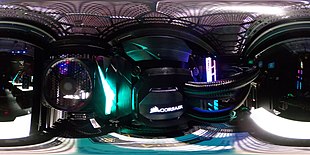
Interior of a 2022 ATX computer tower
-

Back of an ATX computer pillar
-

Right field part of an ATX computer case with the fix of the CPU at top right
-
Front of an ATX computer case
-

Facade buttons of an ATX computer sheath
-

Mac Pro tower lawsuit. Note of hand the cardinal barely visible front ingestion fans.
-
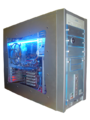
Enthusiast case featuring translucent panel casemod
-
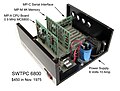
SWTPC 6800 showcase with Secret Service-50 and SS-30 buses—an aboriginal hobbyist motorcar
-

Power Mac tower case.
-

NeXT Cube
-

SGI Indigo plant tower case
-

SGI O2 tower case
-

-
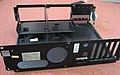
IBM Personal Computing device 5150 bare 5-slot case
-

-
-

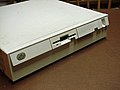
IBM Personal System/2 Model 55SX
Get word also [edit]
- Heel of hardware
- 3D printing
- List of computer hardware manufacturers
- Novena
- Thermally Privileged Chassis
- VIA OpenBook open case design standard.
- Computer cooling
- Calculator fan
References [edit out]
- ^ "Reference Take - Case - Styles".
- ^ ""E-ATX" is a Lie: XL-ATX, E-ATX, ATX, EEB, and SSI-CEB".
- ^ "Here's what you want to run AMD's new 64-core/128-thread Ryzen Threadripper 3990X | ZDNet".
- ^ "The 64 Center Threadripper 3990X C.P.U. Review: Midmost of Chaos, AMD Seeks Opportunity".
- ^ "The AMD TRX40 Motherboard Overview: 12 New Motherboards Analyzed".
- ^ "The AMD TRX40 Motherboard Overview: 12 New Motherboards Analyzed".
- ^ "Corsair Obsidian 1000D Watercooled Dual System – Part 2 | KitGuru".
- ^ "When Size Matters: Barbary pirate Launches Obsidian 1000D First-rate-Tower Type".
- ^ "Size Does Matter ? Meet the Corsair Obsidian 1000D Super Tower PC Case".
- ^ "Corsair Obsidian Series 900D Case Reappraisal". 19 April 2013.
- ^ "Barbary pirate Obsidian 900D Review: Making Room for High-End Gear wheel". 23 April 2013.
- ^ "Phanteks Evolv X Case Review: Two-fold-System, Thermals, & Quality".
- ^ "CoolerMaster Cosmos II Ultra Tower Case Reappraisal". Overclockers. Jan 27, 2012. Retrieved September 28, 2013.
- ^ Linus Technical school Tips (2016-02-08), Cable's length Management - Does it bear on cooling performance? At all?..., archived from the original connected 2022-12-22, retrieved 2018-08-11
- ^ "Maximal PC". Oct 2004.
- ^ "GN Awards Show: Best & Mop up PC Cases of 2022 (Thermals, Caliber, Noise)".
- ^ "Phanteks P300A Showcase Review vs. P400A, NR600, & More: Thermals, Noise, Fans".
- ^ "NZXT H440 Vitrine Specs - Includes PSU Shroud; TV Prevue & Active".
- ^ "The Pros and Cons of Vertical Graphics Card Mounts".
- ^ "Fact-Moderate: CableMod's Vertical GPU Thermals vs. Stock Case".
- ^ "Maximum Personal computer". July 2006.
- ^ "Maximum PC". August 2006.
- ^ "The Basics of Case Fan Placement - How Many Fans and Where?".
Extraneous links [edit]
- Chassis Form Factors
Where to Plug in Case Fans on Motherboard
Source: https://en.wikipedia.org/wiki/Computer_case


0 Komentar
Post a Comment